sporco.admm.bpdn
Classes for ADMM algorithm for the BPDN problem
Classes
|
Base class for ADMM algorithm for solving variants of the Basis Pursuit DeNoising (BPDN) [16] problem. |
|
ADMM algorithm for the Basis Pursuit DeNoising (BPDN) [16] problem. |
|
ADMM algorithm for BPDN with joint sparsity via an \(\ell_{2,1}\) norm term. |
|
ADMM algorithm for the elastic net [64] problem. |
|
ADMM algorithm for a BPDN variant with projection onto the \(\ell_1\) ball instead of an \(\ell_1\) penalty. |
|
ADMM algorithm for the problem with an \(\ell_1\) objective and an \(\ell_2\) constraint. |
Class Descriptions
- class sporco.admm.bpdn.GenericBPDN(*args, **kwargs)[source]
Bases:
ADMMEqualBase class for ADMM algorithm for solving variants of the Basis Pursuit DeNoising (BPDN) [16] problem.
The generic problem form is
\[\mathrm{argmin}_\mathbf{x} \; (1/2) \| D \mathbf{x} - \mathbf{s} \|_2^2 + g(\mathbf{x}) \;\;,\]where \(g(\cdot)\) is a penalty term or the indicator function of a constraint, and is solved via the ADMM problem
\[\mathrm{argmin}_{\mathbf{x}, \mathbf{y}} \; (1/2) \| D \mathbf{x} - \mathbf{s} \|_2^2 + g(\mathbf{y}) \quad \text{such that} \quad \mathbf{x} = \mathbf{y} \;\;.\]After termination of the
solvemethod, attributeitstatis a list of tuples representing statistics of each iteration. The fields of the named tupleIterationStatsare:
Iter: Iteration number
ObjFun: Objective function value
DFid: Value of data fidelity term \((1/2) \| D \mathbf{x} - \mathbf{s} \|_2^2\)
Reg: Value of regularisation term
PrimalRsdl: Norm of primal residual
DualRsdl: Norm of dual residual
EpsPrimal: Primal residual stopping tolerance \(\epsilon_{\mathrm{pri}}\)
EpsDual: Dual residual stopping tolerance \(\epsilon_{\mathrm{dua}}\)
Rho: Penalty parameter
Time: Cumulative run time
- Parameters:
- Darray_like, shape (N, M)
Dictionary matrix
- Sarray_like, shape (N, K)
Signal vector or matrix
- opt
BPDN.OptionsobjectAlgorithm options
- class Options(opt=None)[source]
Bases:
OptionsGenericBPDN algorithm options
Options include all of those defined in
admm.ADMMEqual.Options, together with additional options:
AuxVarObj: Flag indicating whether the objective function should be evaluated using variable X (False) or Y (True) as its argument. Setting this flag toTrueoften gives a better estimate of the objective function.
LinSolveCheck: Flag indicating whether to compute relative residual of X step solver.
NonNegCoef: IfTrue, force solution to be non-negative.
- Parameters:
- optdict or None, optional (default None)
GenericBPDN algorithm options
- defaults = {'AbsStopTol': 0.0, 'AutoRho': {'AutoScaling': True, 'Enabled': True, 'Period': 10, 'RsdlRatio': 1.2, 'RsdlTarget': None, 'Scaling': 1000.0, 'StdResiduals': False}, 'AuxVarObj': True, 'Callback': None, 'DataType': None, 'FastSolve': False, 'IterTimer': 'solve', 'LinSolveCheck': False, 'MaxMainIter': 1000, 'NonNegCoef': False, 'RelStopTol': 0.001, 'RelaxParam': 1.8, 'ReturnX': False, 'StatusHeader': True, 'U0': None, 'Verbose': False, 'Y0': None, 'fEvalX': False, 'gEvalY': True, 'rho': None}
Default content and allowed dict keys
- itstat_fields_objfn = ('ObjFun', 'DFid', 'Reg')
Fields in IterationStats associated with the objective function; see
eval_objfn
- itstat_fields_extra = ('XSlvRelRes',)
Non-standard fields in IterationStats; see
itstat_extra
- hdrtxt_objfn = ('Fnc', 'DFid', 'Reg')
Display column headers associated with the objective function; see
eval_objfn
- hdrval_objfun = {'DFid': 'DFid', 'Fnc': 'ObjFun', 'Reg': 'Reg'}
Dictionary mapping display column headers in
hdrtxt_objfnto IterationStats entries
- ystep()[source]
Minimise Augmented Lagrangian with respect to \(\mathbf{y}\). If this method is not overridden, the problem is solved without any regularisation other than the option enforcement of non-negativity of the solution. When it is overridden, it should be explicitly called at the end of the overriding method.
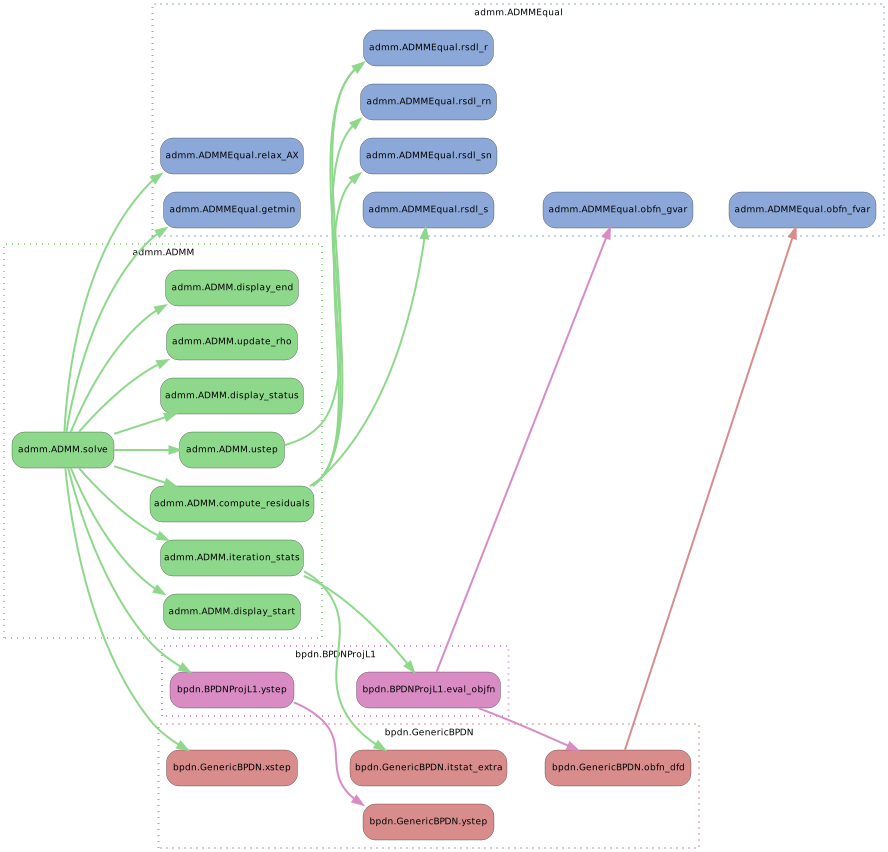
- class sporco.admm.bpdn.BPDN(*args, **kwargs)[source]
Bases:
GenericBPDNADMM algorithm for the Basis Pursuit DeNoising (BPDN) [16] problem.
Solve the Single Measurement Vector (SMV) BPDN problem
\[\mathrm{argmin}_\mathbf{x} \; (1/2) \| D \mathbf{x} - \mathbf{s} \|_2^2 + \lambda \| \mathbf{x} \|_1\]via the ADMM problem
\[\mathrm{argmin}_{\mathbf{x}, \mathbf{y}} \; (1/2) \| D \mathbf{x} - \mathbf{s} \|_2^2 + \lambda \| \mathbf{y} \|_1 \quad \text{such that} \quad \mathbf{x} = \mathbf{y} \;\;.\]The Multiple Measurement Vector (MMV) BPDN problem
\[\mathrm{argmin}_X \; (1/2) \| D X - S \|_F^2 + \lambda \| X \|_1\]is also supported.
After termination of the
solvemethod, attributeitstatis a list of tuples representing statistics of each iteration. The fields of the named tupleIterationStatsare:
Iter: Iteration number
ObjFun: Objective function value
DFid: Value of data fidelity term \((1/2) \| D \mathbf{x} - \mathbf{s} \|_2^2\)
RegL1: Value of regularisation term \(\| \mathbf{x} \|_1\)
PrimalRsdl: Norm of primal residual
DualRsdl: Norm of dual residual
EpsPrimal: Primal residual stopping tolerance \(\epsilon_{\mathrm{pri}}\)
EpsDual: Dual residual stopping tolerance \(\epsilon_{\mathrm{dua}}\)
Rho: Penalty parameter
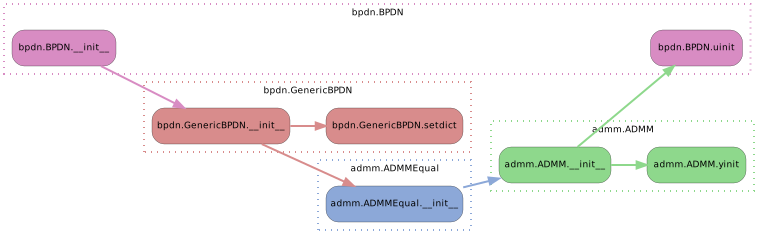
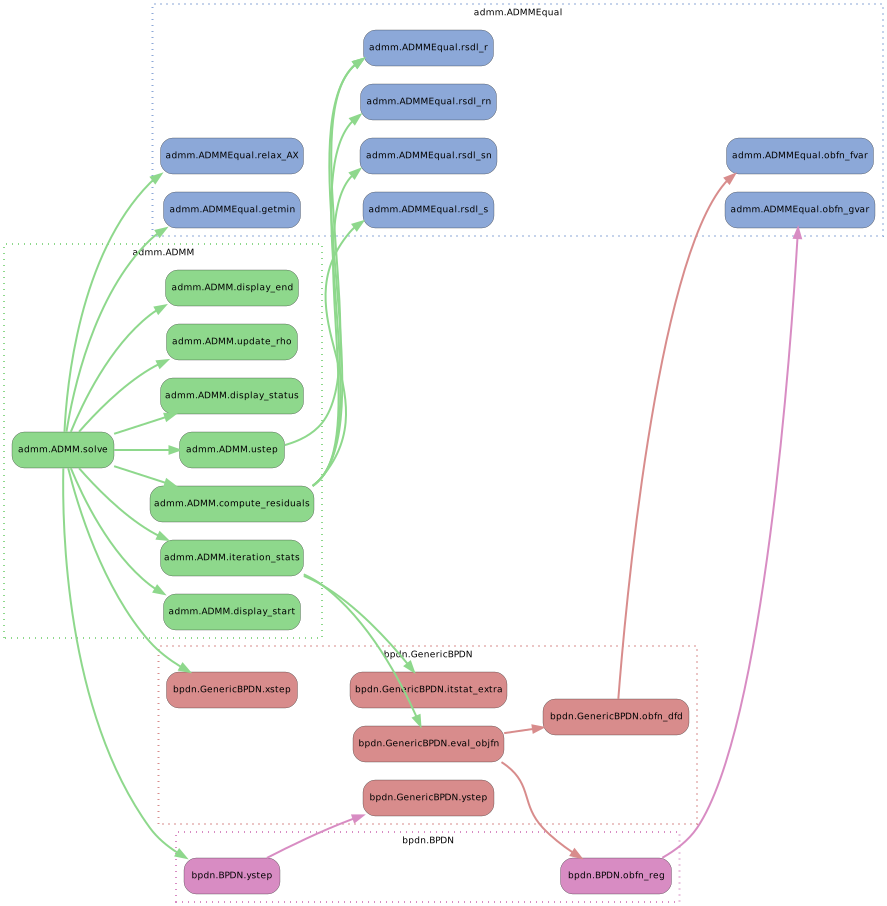
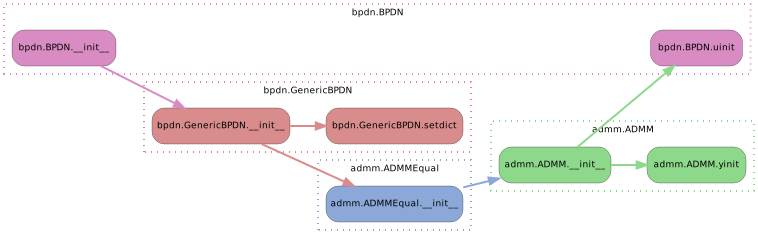
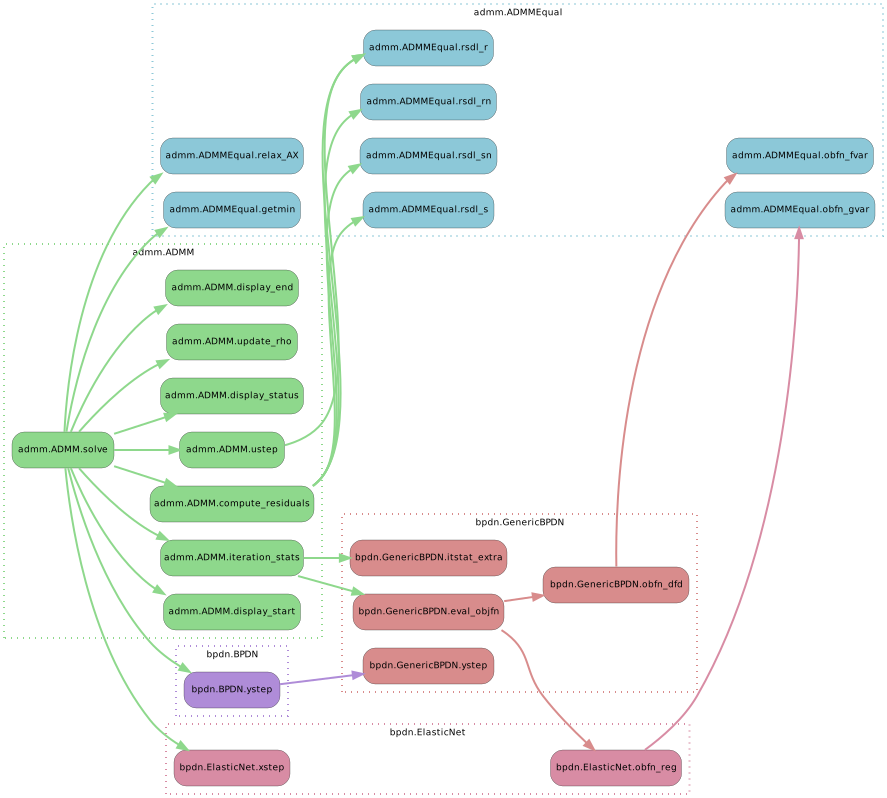
Time: Cumulative run timeCall graph
- Parameters:
- Darray_like, shape (N, M)
Dictionary matrix
- Sarray_like, shape (N, K)
Signal vector or matrix
- lmbdafloat
Regularisation parameter
- opt
BPDN.OptionsobjectAlgorithm options
- class Options(opt=None)[source]
Bases:
OptionsBPDN algorithm options
Options include all of those defined in
GenericBPDN.Options, together with additional options:
L1Weight: An array of weights for the \(\ell_1\) norm. The array shape must be such that the array is compatible for multiplication with the X/Y variables. If this option is defined, the regularization term is \(\lambda \| \mathbf{w} \odot \mathbf{x} \|_1\) where \(\mathbf{w}\) denotes the weighting array.
- Parameters:
- optdict or None, optional (default None)
BPDN algorithm options
- defaults = {'AbsStopTol': 0.0, 'AutoRho': {'AutoScaling': True, 'Enabled': True, 'Period': 10, 'RsdlRatio': 1.2, 'RsdlTarget': None, 'Scaling': 1000.0, 'StdResiduals': False}, 'AuxVarObj': True, 'Callback': None, 'DataType': None, 'FastSolve': False, 'IterTimer': 'solve', 'L1Weight': 1.0, 'LinSolveCheck': False, 'MaxMainIter': 1000, 'NonNegCoef': False, 'RelStopTol': 0.001, 'RelaxParam': 1.8, 'ReturnX': False, 'StatusHeader': True, 'U0': None, 'Verbose': False, 'Y0': None, 'fEvalX': False, 'gEvalY': True, 'rho': None}
Default content and allowed dict keys
- itstat_fields_objfn = ('ObjFun', 'DFid', 'RegL1')
Fields in IterationStats associated with the objective function; see
eval_objfn
- hdrtxt_objfn = ('Fnc', 'DFid', 'Regℓ1')
Display column headers associated with the objective function; see
eval_objfn
- hdrval_objfun = {'DFid': 'DFid', 'Fnc': 'ObjFun', 'Regℓ1': 'RegL1'}
Dictionary mapping display column headers in
hdrtxt_objfnto IterationStats entries
- solve()
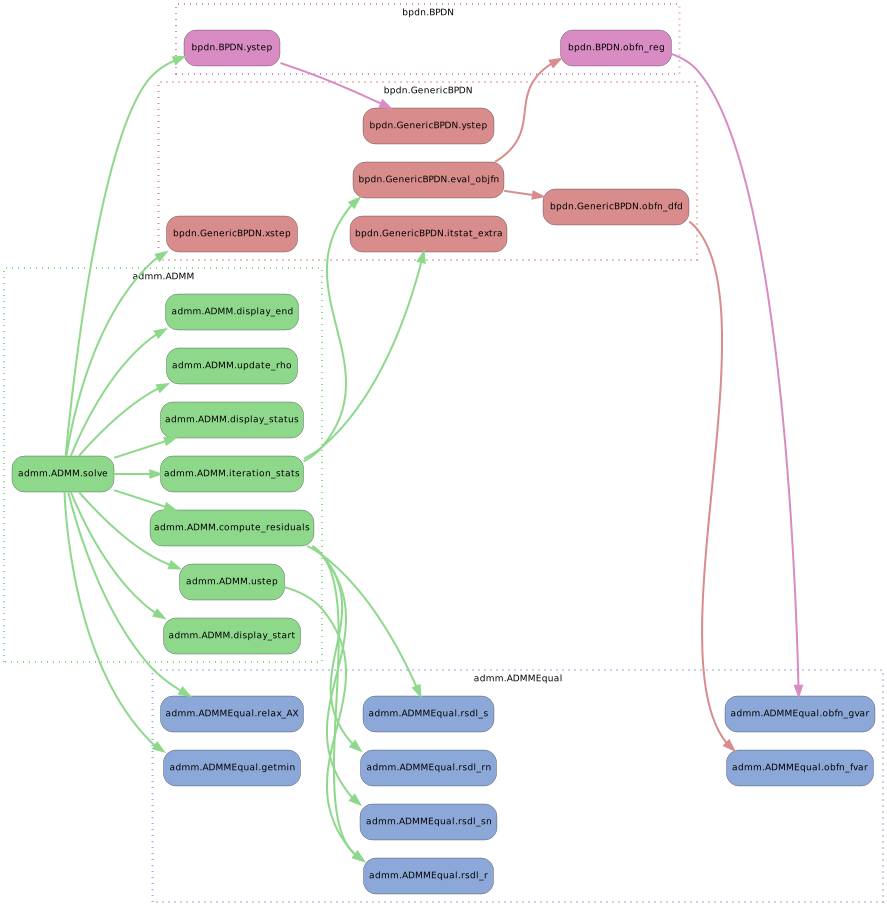
Call graph
- class sporco.admm.bpdn.BPDNJoint(*args, **kwargs)[source]
Bases:
BPDNADMM algorithm for BPDN with joint sparsity via an \(\ell_{2,1}\) norm term.
Solve the optimisation problem
\[\mathrm{argmin}_X \; (1/2) \| D X - S \|_2^2 + \lambda \| X \|_1 + \mu \| X \|_{2,1}\]via the ADMM problem
\[\mathrm{argmin}_{X, Y} \; (1/2) \| D X - S \|_2^2 + \lambda \| Y \|_1 + \mu \| Y \|_{2,1} \quad \text{such that} \quad X = Y \;\;.\]After termination of the
solvemethod, attributeitstatis a list of tuples representing statistics of each iteration. The fields of the named tupleIterationStatsare:
Iter: Iteration number
ObjFun: Objective function value
DFid: Value of data fidelity term \((1/2) \| D X - S \|_2^2\)
RegL1: Value of regularisation term \(\| X \|_1\)
RegL21: Value of regularisation term \(\| X \|_{2,1}\)
PrimalRsdl: Norm of primal residual
DualRsdl: Norm of dual Residual
EpsPrimal: Primal residual stopping tolerance \(\epsilon_{\mathrm{pri}}\)
EpsDual: Dual residual stopping tolerance \(\epsilon_{\mathrm{dua}}\)
Rho: Penalty parameter
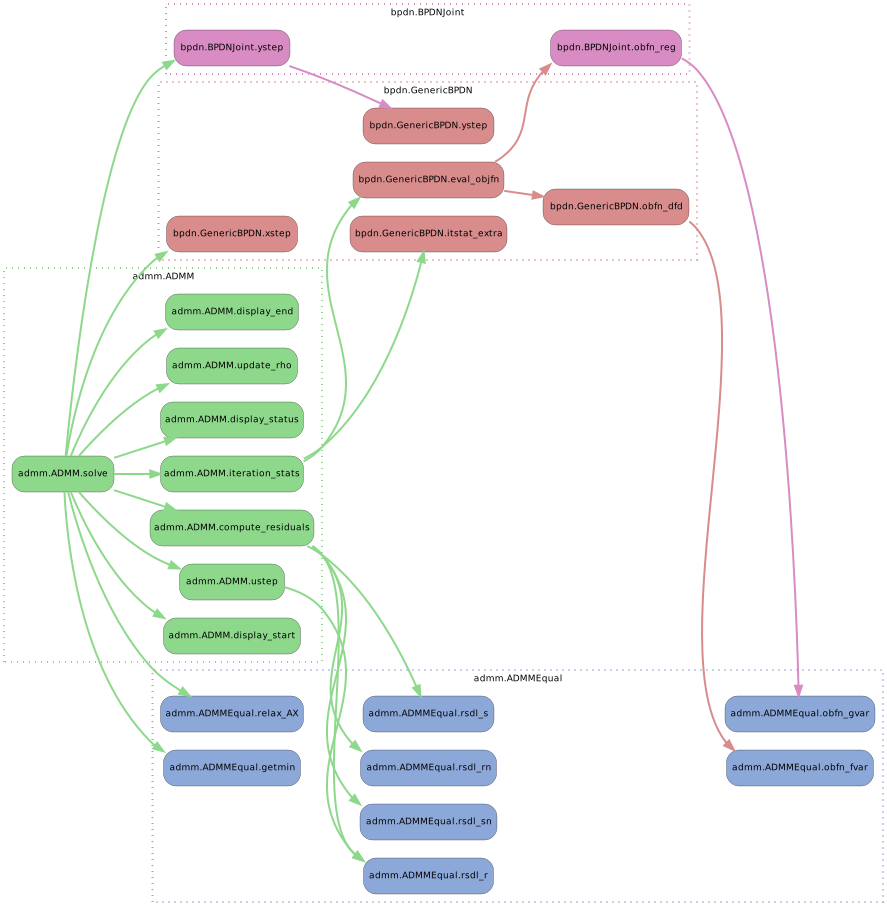
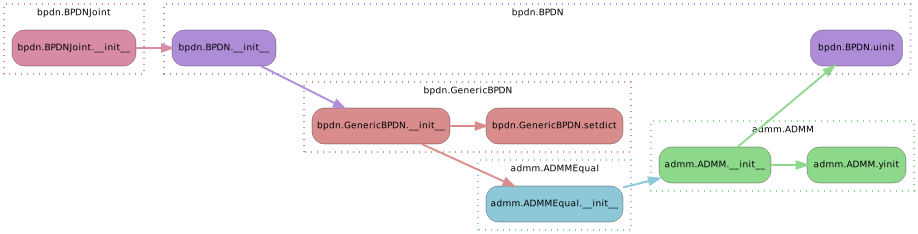
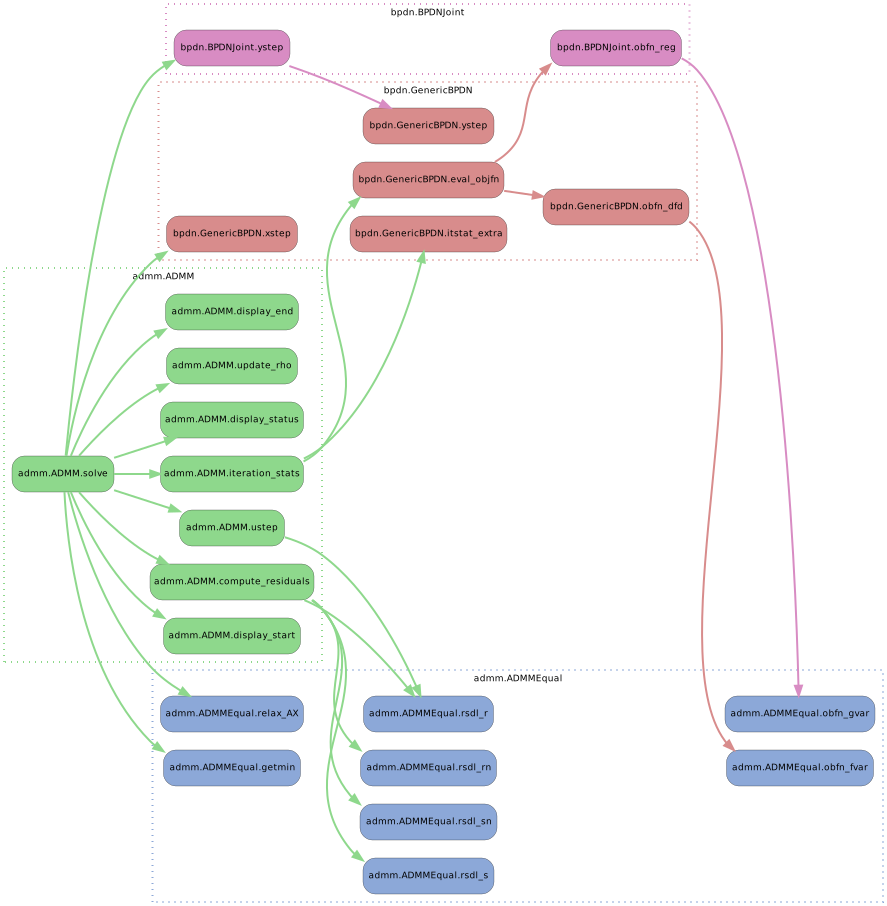
Time: Cumulative run timeCall graph
- Parameters:
- Darray_like, shape (N, M)
Dictionary matrix
- Sarray_like, shape (M, K)
Signal vector or matrix
- lmbdafloat
Regularisation parameter (l1)
- mufloat
Regularisation parameter (l2,1)
- opt
BPDN.OptionsobjectAlgorithm options
- itstat_fields_objfn = ('ObjFun', 'DFid', 'RegL1', 'RegL21')
Fields in IterationStats associated with the objective function; see
eval_objfn
- hdrtxt_objfn = ('Fnc', 'DFid', 'Regℓ1', 'Regℓ2,1')
Display column headers associated with the objective function; see
eval_objfn
- hdrval_objfun = {'DFid': 'DFid', 'Fnc': 'ObjFun', 'Regℓ1': 'RegL1', 'Regℓ2,1': 'RegL21'}
Dictionary mapping display column headers in
hdrtxt_objfnto IterationStats entries
- obfn_reg()[source]
Compute regularisation terms and contribution to objective function. Regularisation terms are \(\| Y \|_1\) and \(\| Y \|_{2,1}\).
- solve()
Call graph
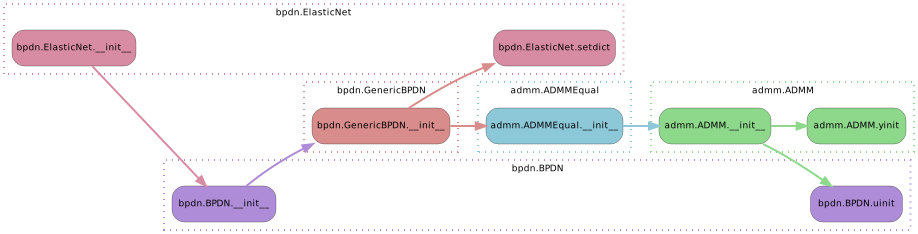
- class sporco.admm.bpdn.ElasticNet(*args, **kwargs)[source]
Bases:
BPDNADMM algorithm for the elastic net [64] problem.
Solve the optimisation problem
\[\mathrm{argmin}_\mathbf{x} \; (1/2) \| D \mathbf{x} - \mathbf{s} \|_2^2 + \lambda \| \mathbf{x} \|_1 + (\mu/2) \| \mathbf{x} \|_2^2\]via the ADMM problem
\[\mathrm{argmin}_{\mathbf{x}, \mathbf{y}} \; (1/2) \| D \mathbf{x} - \mathbf{s} \|_2^2 + \lambda \| \mathbf{y} \|_1 + (\mu/2) \| \mathbf{x} \|_2^2 \quad \text{such that} \quad \mathbf{x} = \mathbf{y} \;\;.\]After termination of the
solvemethod, attributeitstatis a list of tuples representing statistics of each iteration. The fields of the named tupleIterationStatsare:
Iter: Iteration number
ObjFun: Objective function value
DFid: Value of data fidelity term \((1/2) \| D \mathbf{x} - \mathbf{s} \|_2^2\)
RegL1: Value of regularisation term \(\| \mathbf{x} \|_1\)
RegL2: Value of regularisation term \((1/2) \| \mathbf{x} \|_2^2\)
PrimalRsdl: Norm of primal residual
DualRsdl: Norm of dual Residual
EpsPrimal: Primal residual stopping tolerance \(\epsilon_{\mathrm{pri}}\)
EpsDual: Dual residual stopping tolerance \(\epsilon_{\mathrm{dua}}\)
Rho: Penalty parameter
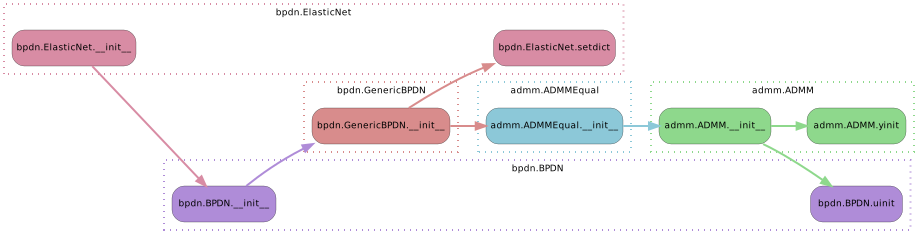
Time: Cumulative run timeCall graph
- Parameters:
- Darray_like, shape (N, M)
Dictionary matrix
- Sarray_like, shape (M, K)
Signal vector or matrix
- lmbdafloat
Regularisation parameter (l1)
- mufloat
Regularisation parameter (l2)
- opt
BPDN.OptionsobjectAlgorithm options
- itstat_fields_objfn = ('ObjFun', 'DFid', 'RegL1', 'RegL2')
Fields in IterationStats associated with the objective function; see
eval_objfn
- hdrtxt_objfn = ('Fnc', 'DFid', 'Regℓ1', 'Regℓ2')
Display column headers associated with the objective function; see
eval_objfn
- hdrval_objfun = {'DFid': 'DFid', 'Fnc': 'ObjFun', 'Regℓ1': 'RegL1', 'Regℓ2': 'RegL2'}
Dictionary mapping display column headers in
hdrtxt_objfnto IterationStats entries
- solve()
Call graph
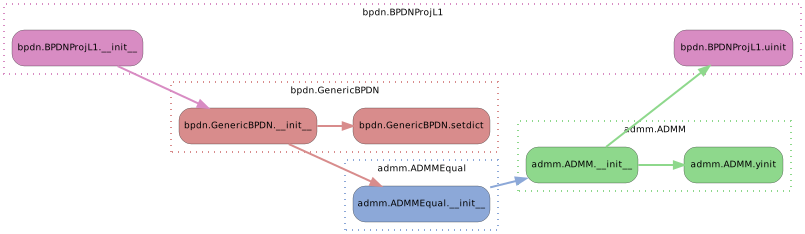
- class sporco.admm.bpdn.BPDNProjL1(*args, **kwargs)[source]
Bases:
GenericBPDNADMM algorithm for a BPDN variant with projection onto the \(\ell_1\) ball instead of an \(\ell_1\) penalty.
This variant of the BPDN problem was originally referred to as the lasso [46], but that name is now also frequently applied to the penalised form that is referred to here as the BPDN problem.
Solve the problem
\[\mathrm{argmin}_\mathbf{x} \; (1/2) \| D \mathbf{x} - \mathbf{s} \|_2^2 \; \text{such that} \; \| \mathbf{x} \|_1 \leq \gamma\]via the ADMM problem
\[\mathrm{argmin}_{\mathbf{x}, \mathbf{y}} \; (1/2) \| D \mathbf{x} - \mathbf{s} \|_2^2 + \iota_{C(\gamma)} (\mathbf{y}) \quad \text{such that} \quad \mathbf{x} = \mathbf{y} \;\;,\]where \(\iota_{C(\gamma)}(\cdot)\) is the indicator function of the \(\ell_1\) ball of radius \(\gamma\) about the origin. The algorithm is very similar to that for the BPDN problem (see
BPDN), the only difference being in the replacement in the \(\mathbf{y}\) step of the proximal operator of the \(\ell_1\) norm with the projection operator of the \(\ell_1\) norm.After termination of the
solvemethod, attributeitstatis a list of tuples representing statistics of each iteration. The fields of the named tupleIterationStatsare:
Iter: Iteration number
ObjFun: Objective function value \((1/2) \| D \mathbf{x} - \mathbf{s} \|_2^2\)
Cnstr: Constraint violation measure
PrimalRsdl: Norm of primal residual
DualRsdl: Norm of dual residual
EpsPrimal: Primal residual stopping tolerance \(\epsilon_{\mathrm{pri}}\)
EpsDual: Dual residual stopping tolerance \(\epsilon_{\mathrm{dua}}\)
Rho: Penalty parameter
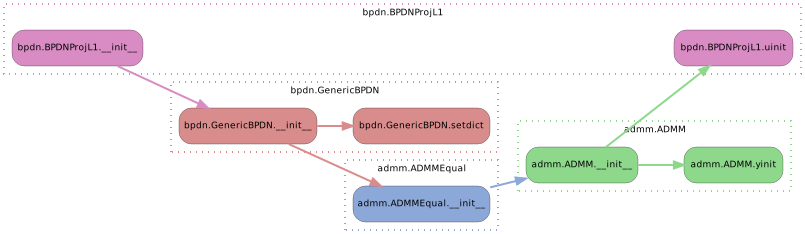
Time: Cumulative run timeCall graph
- Parameters:
- Darray_like, shape (N, M)
Dictionary matrix
- Sarray_like, shape (N, K)
Signal vector or matrix
- gammafloat
Constraint parameter
- opt
BPDNProjL1.OptionsobjectAlgorithm options
- class Options(opt=None)[source]
Bases:
OptionsBPDNProjL1 algorithm options
Options are the same as those defined in
GenericBPDN.Options.
- Parameters:
- optdict or None, optional (default None)
BPDNProjL1 algorithm options
- defaults = {'AbsStopTol': 0.0, 'AutoRho': {'AutoScaling': True, 'Enabled': True, 'Period': 10, 'RsdlRatio': 1.2, 'RsdlTarget': 1.0, 'Scaling': 1000.0, 'StdResiduals': False}, 'AuxVarObj': True, 'Callback': None, 'DataType': None, 'FastSolve': False, 'IterTimer': 'solve', 'LinSolveCheck': False, 'MaxMainIter': 1000, 'NonNegCoef': False, 'RelStopTol': 0.001, 'RelaxParam': 1.8, 'ReturnX': False, 'StatusHeader': True, 'U0': None, 'Verbose': False, 'Y0': None, 'fEvalX': False, 'gEvalY': True, 'rho': None}
Default content and allowed dict keys
- itstat_fields_objfn = ('ObjFun', 'Cnstr')
Fields in IterationStats associated with the objective function; see
eval_objfn
- hdrtxt_objfn = ('Fnc', 'Cnstr')
Display column headers associated with the objective function; see
eval_objfn
- hdrval_objfun = {'Cnstr': 'Cnstr', 'Fnc': 'ObjFun'}
Dictionary mapping display column headers in
hdrtxt_objfnto IterationStats entries
- eval_objfn()[source]
Compute components of regularisation function as well as total contribution to objective function.
- solve()
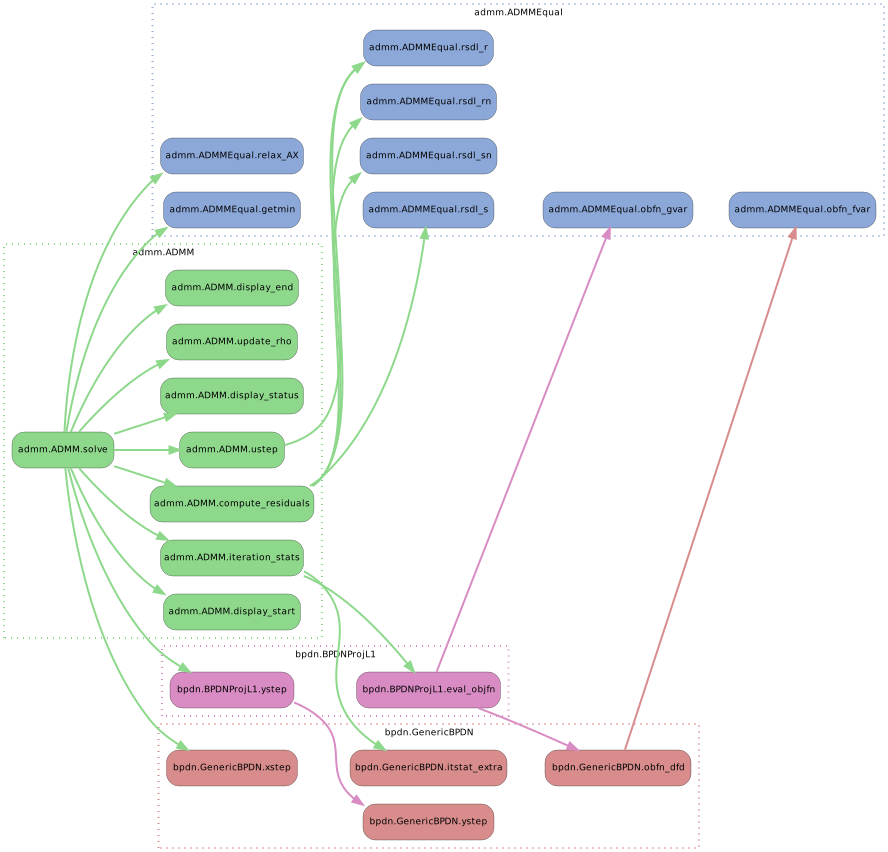
Call graph
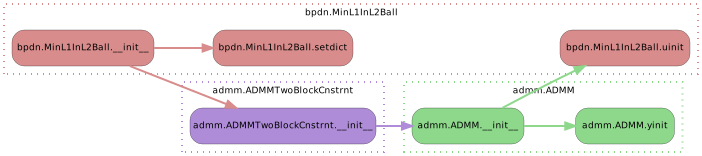
- class sporco.admm.bpdn.MinL1InL2Ball(*args, **kwargs)[source]
Bases:
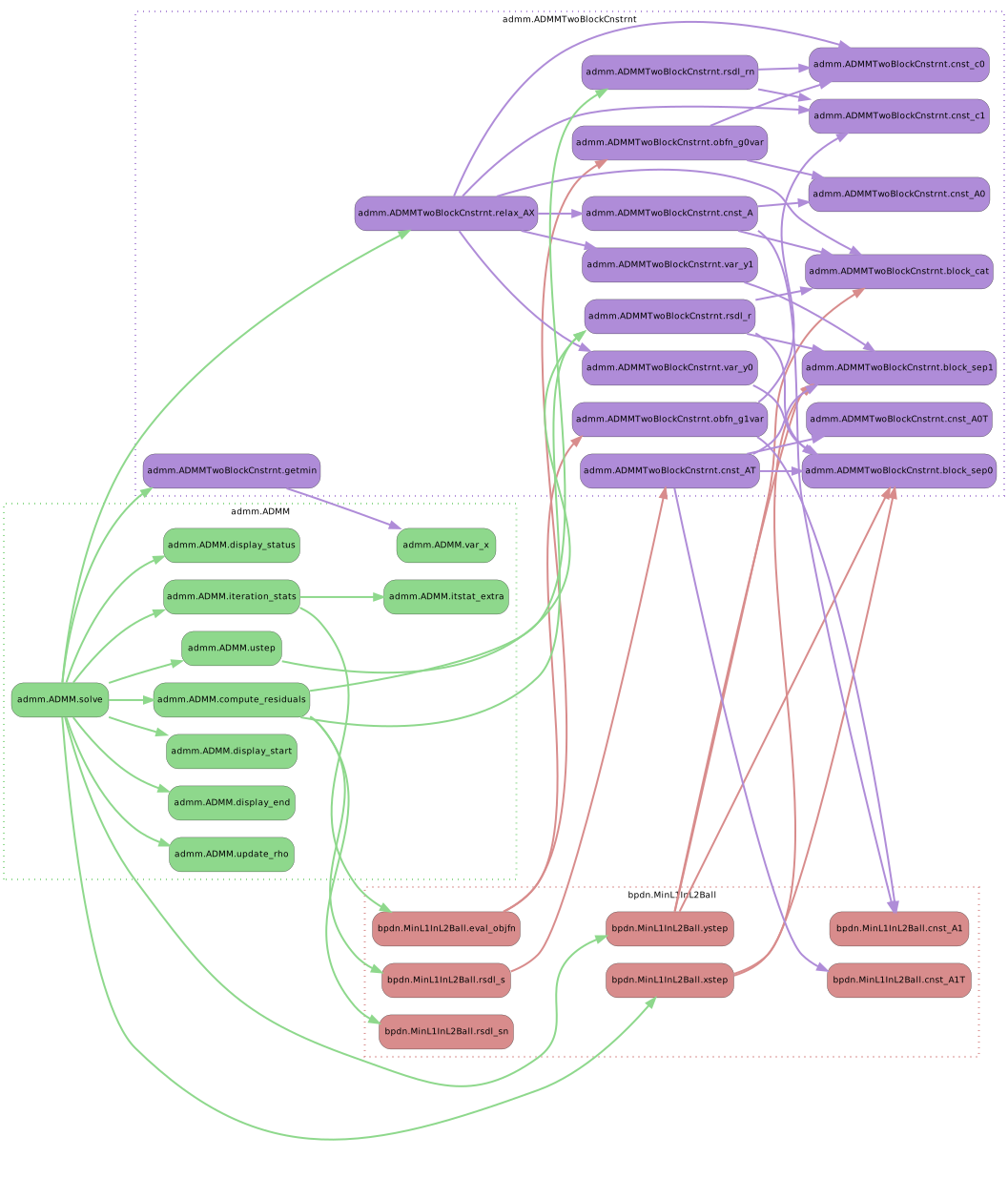
ADMMTwoBlockCnstrntADMM algorithm for the problem with an \(\ell_1\) objective and an \(\ell_2\) constraint.
The solution is computed following the approach proposed in [2].
Solve the Single Measurement Vector (SMV) problem
\[\mathrm{argmin}_\mathbf{x} \| \mathbf{x} \|_1 \; \text{such that} \; \| D \mathbf{x} - \mathbf{s} \|_2 \leq \epsilon\]via the ADMM problem
\[\begin{split}\mathrm{argmin}_{\mathbf{x},\mathbf{y}_0,\mathbf{y}_1} \; \| \mathbf{y}_0 \|_1 + \iota_{C(\mathbf{s}, \epsilon)} (\mathbf{y}_1) \;\text{such that}\; \left( \begin{array}{c} I \\ D \end{array} \right) \mathbf{x} - \left( \begin{array}{c} \mathbf{y}_0 \\ \mathbf{y}_1 \end{array} \right) = \left( \begin{array}{c} \mathbf{0} \\ \mathbf{0} \end{array} \right) \;\;,\end{split}\]where \(\iota_{C(\mathbf{s}, \epsilon)}(\cdot)\) is the indicator function of the \(\ell_2\) ball of radius \(\epsilon\) about \(\mathbf{s}\). The Multiple Measurement Vector (MMV) problem
\[\mathrm{argmin}_X \| X \|_1 \; \text{such that} \; \| [D X - S]_k \|_2 \leq \epsilon \;\;\; \forall k \;\;,\]where \([X]_k\) denotes column \(k\) of matrix \(X\), is also supported.
After termination of the
solvemethod, attributeitstatis a list of tuples representing statistics of each iteration. The fields of the named tupleIterationStatsare:
Iter: Iteration number
ObjFun: Objective function value \(\| \mathbf{x} \|_1\)
Cnstr: Constraint violation measure
PrimalRsdl: Norm of primal residual
DualRsdl: Norm of dual residual
EpsPrimal: Primal residual stopping tolerance \(\epsilon_{\mathrm{pri}}\)
EpsDual: Dual residual stopping tolerance \(\epsilon_{\mathrm{dua}}\)
Rho: Penalty parameter
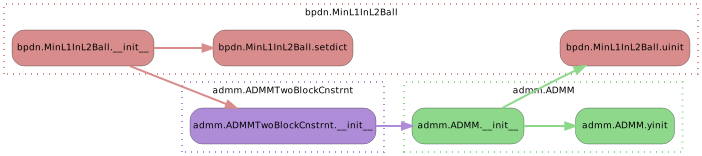
Time: Cumulative run timeCall graph
- Parameters:
- Darray_like, shape (N, M)
Dictionary matrix
- Sarray_like, shape (N, K)
Signal vector or matrix
- epsilonfloat
\(\ell_2\) ball radius
- opt
MinL1InL2Ball.OptionsobjectAlgorithm options
- class Options(opt=None)[source]
Bases:
OptionsMinL1InL2Ball algorithm options
Options include all of those defined in
admm.ADMMTwoBlockCnstrnt.Options, together with additional options:
L1Weight: An array of weights for the \(\ell_1\) norm. The array shape must be such that the array is compatible for multiplication with the X/Y variables. If this option is defined, the objective function is \(\lambda \| \mathbf{w} \odot \mathbf{x} \|_1\) where \(\mathbf{w}\) denotes the weighting array.
NonNegCoef: IfTrue, force solution to be non-negative.
- Parameters:
- optdict or None, optional (default None)
MinL1InL2Ball algorithm options
- defaults = {'AbsStopTol': 0.0, 'AutoRho': {'AutoScaling': True, 'Enabled': True, 'Period': 10, 'RsdlRatio': 1.2, 'RsdlTarget': 1.0, 'Scaling': 1000.0, 'StdResiduals': False}, 'AuxVarObj': False, 'Callback': None, 'DataType': None, 'FastSolve': False, 'IterTimer': 'solve', 'L1Weight': 1.0, 'MaxMainIter': 1000, 'NonNegCoef': False, 'RelStopTol': 0.001, 'RelaxParam': 1.8, 'ReturnVar': 'X', 'StatusHeader': True, 'U0': None, 'Verbose': False, 'Y0': None, 'fEvalX': True, 'gEvalY': False, 'rho': None}
Default content and allowed dict keys
- itstat_fields_objfn = ('ObjFun', 'Cnstr')
Fields in IterationStats associated with the objective function; see
eval_objfn
- hdrtxt_objfn = ('Fnc', 'Cnstr')
Display column headers associated with the objective function; see
eval_objfn
- hdrval_objfun = {'Cnstr': 'Cnstr', 'Fnc': 'ObjFun'}
Dictionary mapping display column headers in
hdrtxt_objfnto IterationStats entries
- cnst_A1T(X)[source]
Compute \(A_1^T \mathbf{x}\) where \(A_1 \mathbf{x}\) is a component of ADMM problem constraint.
- eval_objfn()[source]
Compute components of objective function as well as total contribution to objective function. The objective function is \(\| \mathbf{x} \|_1\) and the constraint violation measure is \(P(\mathbf{x}) - \mathbf{x}\) where \(P(\mathbf{x})\) is the projection into the constraint set.
- solve()
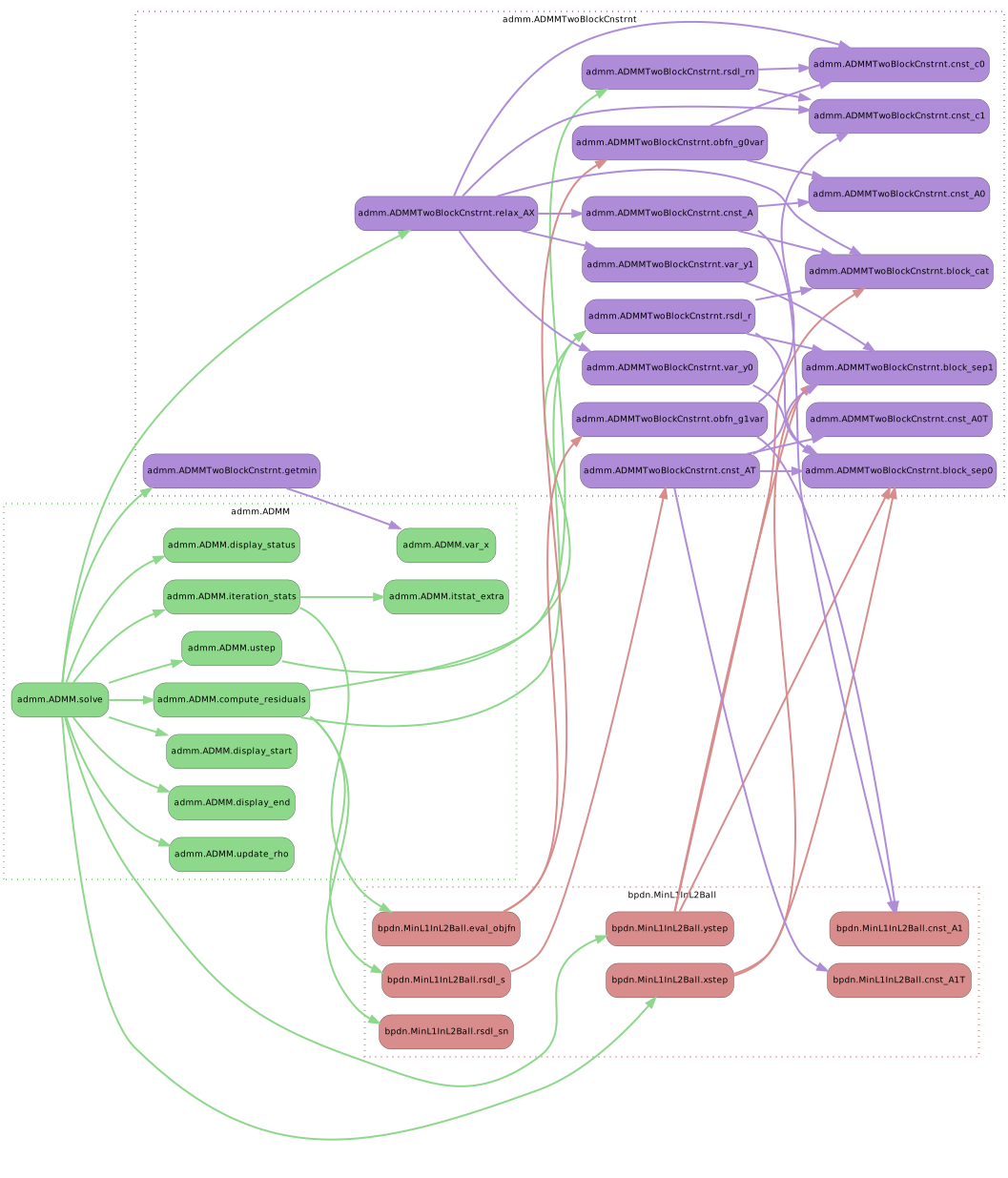
Call graph