sporco.admm.ccmodmd
ADMM algorithms for the Convolutional Constrained MOD problem with Mask Decoupling
Functions
|
A wrapper function that dynamically defines a class derived from one of the implementations of the Convolutional Constrained MOD with Mask Decoupling problems, and returns an object instantiated with the provided. |
|
A wrapper function that dynamically defines a class derived from the Options class associated with one of the implementations of the Convolutional Constrained MOD with Mask Decoupling problem, and returns an object instantiated with the provided parameters. |
Classes
|
Base class for ADMM algorithms for Convolutional Constrained MOD |
|
ADMM algorithm for Convolutional Constrained MOD with Mask Decoupling [28] with the \(\mathbf{x}\) step solved via iterated application of the Sherman-Morrison equation [53]. |
|
ADMM algorithm for Convolutional Constrained MOD with Mask Decoupling [28] with the \(\mathbf{x}\) step solved via Conjugate Gradient (CG) [53]. |
|
Hybrid ADMM Consensus algorithm for Convolutional Constrained MOD with Mask Decoupling [26]. |
Function Descriptions
- sporco.admm.ccmodmd.ConvCnstrMODMaskDcpl(*args, **kwargs)[source]
A wrapper function that dynamically defines a class derived from one of the implementations of the Convolutional Constrained MOD with Mask Decoupling problems, and returns an object instantiated with the provided. parameters. The wrapper is designed to allow the appropriate object to be created by calling this function using the same syntax as would be used if it were a class. The specific implementation is selected by use of an additional keyword argument ‘method’. Valid values are:
'ism': Use the implementation defined inConvCnstrMODMaskDcpl_IterSM. This method works well for a small number of training images, but is very slow for larger training sets.
'cg': Use the implementation defined inConvCnstrMODMaskDcpl_CG. This method is slower than'ism'for small training sets, but has better run time scaling as the training set grows.
'cns': Use the implementation defined inConvCnstrMODMaskDcpl_Consensus. This method is the best choice for large training sets.The default value is
'cns'.
- sporco.admm.ccmodmd.ConvCnstrMODMaskDcplOptions(opt=None, method='cns')[source]
A wrapper function that dynamically defines a class derived from the Options class associated with one of the implementations of the Convolutional Constrained MOD with Mask Decoupling problem, and returns an object instantiated with the provided parameters. The wrapper is designed to allow the appropriate object to be created by calling this function using the same syntax as would be used if it were a class. The specific implementation is selected by use of an additional keyword argument ‘method’. Valid values are as specified in the documentation for
ConvCnstrMODMaskDcpl.
Class Descriptions
- class sporco.admm.ccmodmd.ConvCnstrMODMaskDcplBase(*args, **kwargs)[source]
Bases:
ADMMTwoBlockCnstrntBase class for ADMM algorithms for Convolutional Constrained MOD with Mask Decoupling [28].
Solve the optimisation problem
\[\mathrm{argmin}_\mathbf{d} \; (1/2) \left\| W \left(\sum_m \mathbf{d}_m * \mathbf{x}_m - \mathbf{s}\right) \right\|_2^2 \quad \text{such that} \quad \mathbf{d}_m \in C \;\; \forall m\]where \(C\) is the feasible set consisting of filters with unit norm and constrained support, and \(W\) is a mask array, via the ADMM problem
\[\begin{split}\mathrm{argmin}_{\mathbf{d},\mathbf{g}_0,\mathbf{g}_1} \; (1/2) \| W \mathbf{g}_0 \|_2^2 + \iota_C(\mathbf{g}_1) \;\text{such that}\; \left( \begin{array}{c} X \\ I \end{array} \right) \mathbf{d} - \left( \begin{array}{c} \mathbf{g}_0 \\ \mathbf{g}_1 \end{array} \right) = \left( \begin{array}{c} \mathbf{s} \\ \mathbf{0} \end{array} \right) \;\;,\end{split}\]where \(\iota_C(\cdot)\) is the indicator function of feasible set \(C\), and \(X \mathbf{d} = \sum_m \mathbf{x}_m * \mathbf{d}_m\).
The implementation of this class is substantially complicated by the support of multi-channel signals. In the following, the number of channels in the signal and dictionary are denoted by
CandCdrespectively, the number of signals and the number of filters are denoted byKandMrespectively,X,Z, andSdenote the dictionary, coefficient map, and signal arrays respectively, andY0andY1denote blocks 0 and 1 of the auxiliary (split) variable of the ADMM problem. We need to consider three different cases:
Single channel signal and dictionary (
C=Cd= 1)Multi-channel signal, single channel dictionary (
C> 1,Cd= 1)Multi-channel signal and dictionary (
C=Cd> 1)The final three (non-spatial) dimensions of the main variables in each of these cases are as in the following table:
Var.
C=Cd= 1
C> 1,Cd= 1
C=Cd> 1
X1 x 1 x
M1 x 1 x
M
Cdx 1 xM
Z1 x
KxM
CxKxM1 x
KxM
S1 x
Kx 1
CxKx 1
CxKx 1
Y01 x
Kx 1
CxKx 1
CxKx 1
Y11 x 1 x
M1 x 1 x
M
Cx 1 xMIn order to combine the block components
Y0andY1of variableYinto a single array, we need to be able to concatenate the two component arrays on one of the axes, but the shapesY0andY1are not compatible for concatenation. The solution for cases 1. and 3. is to swap theKandMaxes of Y0` before concatenating, as well as after extracting theY0component from the concatenatedYvariable. In case 2., since theCandKindices have the same behaviour in the dictionary update equation, we combine these axes in__init__, so that the case 2. array shapes become
Var.
C> 1,Cd= 1
X1 x 1 x
M
Z1 x
CKxM
S1 x
CKx 1
Y01 x
CKx 1
Y11 x 1 x
Mmaking it possible to concatenate
Y0andY1using the same axis swapping strategy as in the other cases. Seeblock_sep0andblock_catfor additional details.After termination of the
solvemethod, attributeitstatis a list of tuples representing statistics of each iteration. The fields of the named tupleIterationStatsare:
Iter: Iteration number
DFid: Value of data fidelity term \((1/2) \sum_k \| W (\sum_m \mathbf{d}_m * \mathbf{x}_{k,m} - \mathbf{s}_k) \|_2^2\)
Cnstr: Constraint violation measure
PrimalRsdl: Norm of primal residual
DualRsdl: Norm of dual residual
EpsPrimal: Primal residual stopping tolerance \(\epsilon_{\mathrm{pri}}\)
EpsDual: Dual residual stopping tolerance \(\epsilon_{\mathrm{dua}}\)
Rho: Penalty parameter
XSlvRelRes: Relative residual of X step solver
Time: Cumulative run time
- Parameters:
- Zarray_like
Coefficient map array
- Sarray_like
Signal array
- Warray_like
Mask array. The array shape must be such that the array is compatible for multiplication with the internal shape of input array S (see
cnvrep.CDU_ConvRepIndexingfor a discussion of the distinction between external and internal data layouts) after reshaping to the shape determined bycnvrep.mskWshape.- dsztuple
Filter support size(s)
- opt
ConvCnstrMODMaskDcplBase.OptionsobjectAlgorithm options
- dimK0, 1, or None, optional (default None)
Number of dimensions in input signal corresponding to multiple independent signals
- dimNint, optional (default 2)
Number of spatial dimensions
- class Options(opt=None)[source]
Bases:
OptionsConvCnstrMODMaskDcplBase algorithm options
Options include all of those defined in
ADMMTwoBlockCnstrnt.Options, together with additional options:
LinSolveCheck: Flag indicating whether to compute relative residual of X step solver.
ZeroMean: Flag indicating whether the solution dictionary \(\{\mathbf{d}_m\}\) should have zero-mean components.
- Parameters:
- optdict or None, optional (default None)
ConvCnstrMODMaskDcpl algorithm options
- defaults = {'AbsStopTol': 0.0, 'AutoRho': {'AutoScaling': False, 'Enabled': False, 'Period': 10, 'RsdlRatio': 10.0, 'RsdlTarget': None, 'Scaling': 2.0, 'StdResiduals': False}, 'AuxVarObj': False, 'Callback': None, 'DataType': None, 'FastSolve': False, 'IterTimer': 'solve', 'LinSolveCheck': False, 'MaxMainIter': 1000, 'RelStopTol': 0.001, 'RelaxParam': 1.8, 'ReturnVar': 'Y1', 'ReturnX': True, 'StatusHeader': True, 'U0': None, 'Verbose': False, 'Y0': None, 'ZeroMean': False, 'fEvalX': True, 'gEvalY': False, 'rho': 1.0}
Default content and allowed dict keys
- itstat_fields_objfn = ('DFid', 'Cnstr')
Fields in IterationStats associated with the objective function; see
eval_objfn
- itstat_fields_extra = ('XSlvRelRes',)
Non-standard fields in IterationStats; see
itstat_extra
- hdrtxt_objfn = ('DFid', 'Cnstr')
Display column headers associated with the objective function; see
eval_objfn
- hdrval_objfun = {'Cnstr': 'Cnstr', 'DFid': 'DFid'}
Dictionary mapping display column headers in
hdrtxt_objfnto IterationStats entries
- getdict(crop=True)[source]
Get final dictionary. If
cropisTrue, applycnvrep.bcropto returned array.
- xstep_check(b)[source]
Check the minimisation of the Augmented Lagrangian with respect to \(\mathbf{x}\) by method xstep defined in derived classes. This method should be called at the end of any xstep method.
- block_sep0(Y)[source]
Separate variable into component corresponding to \(\mathbf{y}_0\) in \(\mathbf{y}\;\;\). The method from parent class
ADMMTwoBlockCnstrntis overridden here to allow swapping of K (multi-image) and M (filter) axes in block 0 so that it can be concatenated on axis M with block 1. This is necessary because block 0 has the dimensions of S while block 1 has the dimensions of D. Handling of multi-channel signals substantially complicate this issue. There are two multi-channel cases: multi-channel dictionary and signal (Cd = C > 1), and single-channel dictionary with multi-channel signal (Cd = 1, C > 1). In the former case, S and D shapes are (N x C x K x 1) and (N x C x 1 x M) respectively. In the latter case,__init__has already taken care of combining C (multi-channel) and K (multi-image) axes in S, so the S and D shapes are (N x 1 x C K x 1) and (N x 1 x 1 x M) respectively.
- block_cat(Y0, Y1)[source]
Concatenate components corresponding to \(\mathbf{y}_0\) and \(\mathbf{y}_1\) to form \(\mathbf{y}\;\;\). The method from parent class
ADMMTwoBlockCnstrntis overridden here to allow swapping of K (multi-image) and M (filter) axes in block 0 so that it can be concatenated on axis M with block 1. This is necessary because block 0 has the dimensions of S while block 1 has the dimensions of D. Handling of multi-channel signals substantially complicate this issue. There are two multi-channel cases: multi-channel dictionary and signal (Cd = C > 1), and single-channel dictionary with multi-channel signal (Cd = 1, C > 1). In the former case, S and D shapes are (N x C x K x 1) and (N x C x 1 x M) respectively. In the latter case,__init__has already taken care of combining C (multi-channel) and K (multi-image) axes in S, so the S and D shapes are (N x 1 x C K x 1) and (N x 1 x 1 x M) respectively.
- obfn_g0var()[source]
Variable to be evaluated in computing
ADMMTwoBlockCnstrnt.obfn_g0, depending on theAuxVarObjoption value.
- cnst_A0T(Y0)[source]
Compute \(A_0^T \mathbf{y}_0\) component of \(A^T \mathbf{y}\) (see
ADMMTwoBlockCnstrnt.cnst_AT).
- cnst_c0()[source]
Compute constant component \(\mathbf{c}_0\) of \(\mathbf{c}\) in the ADMM problem constraint.
- class sporco.admm.ccmodmd.ConvCnstrMODMaskDcpl_IterSM(*args, **kwargs)[source]
Bases:
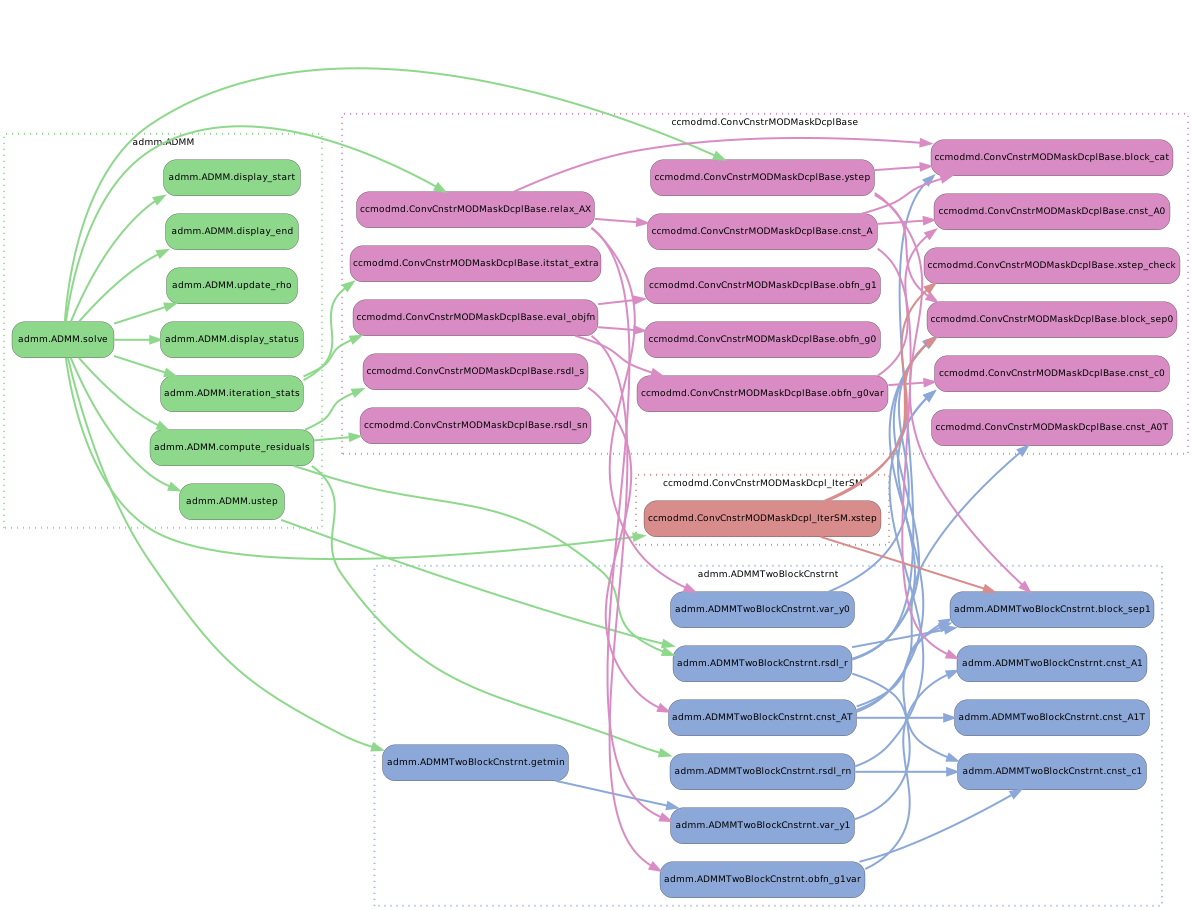
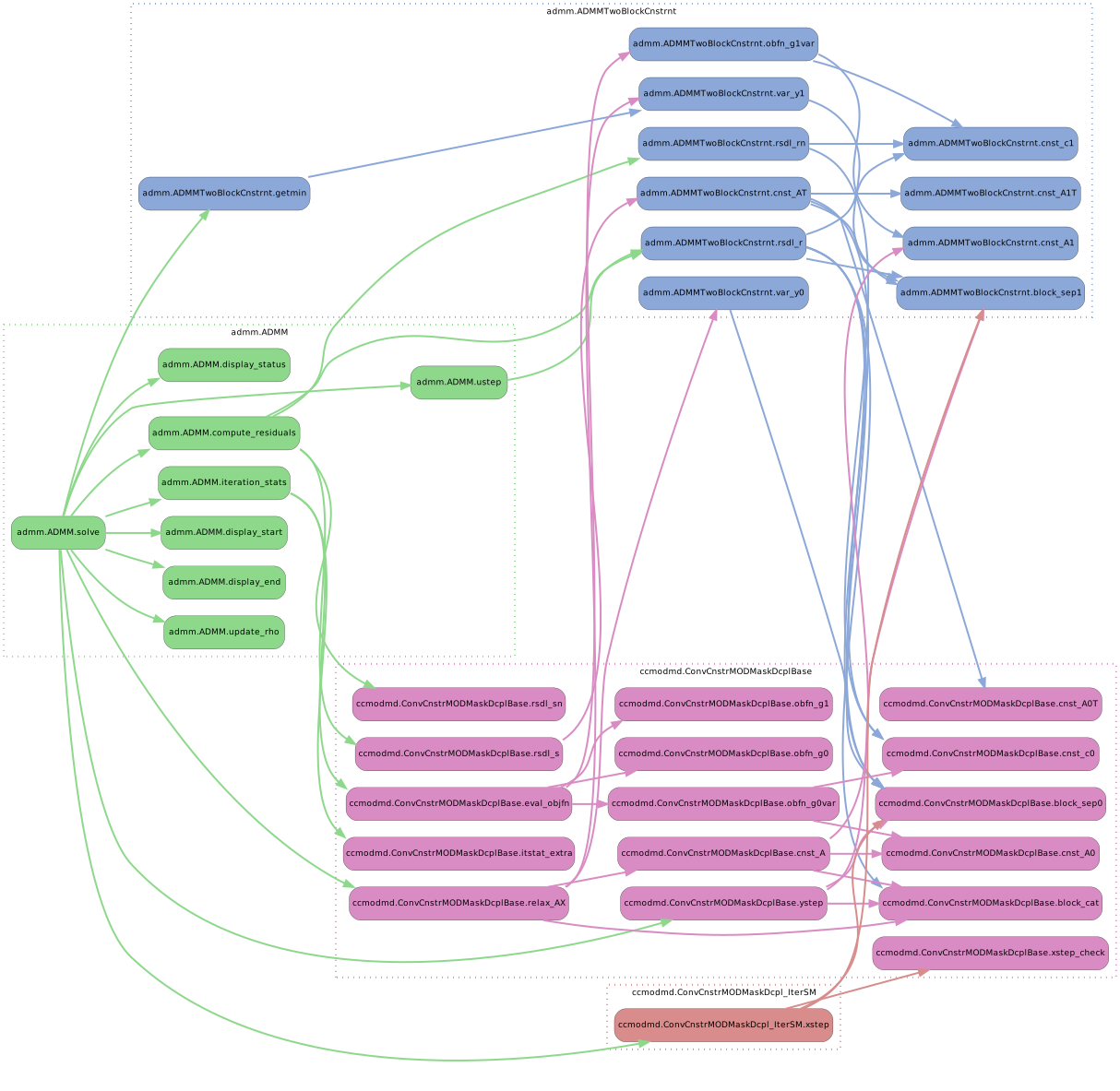
ConvCnstrMODMaskDcplBaseADMM algorithm for Convolutional Constrained MOD with Mask Decoupling [28] with the \(\mathbf{x}\) step solved via iterated application of the Sherman-Morrison equation [53].
Multi-channel signals/images are supported [51]. See
ConvCnstrMODMaskDcplBasefor interface details.Call graph

- class Options(opt=None)[source]
Bases:
OptionsConvCnstrMODMaskDcpl_IterSM algorithm options
Options are the same as those defined in
ConvCnstrMODMaskDcplBase.Options.
- Parameters:
- optdict or None, optional (default None)
ConvCnstrMODMaskDcpl_IterSM algorithm options
- defaults = {'AbsStopTol': 0.0, 'AutoRho': {'AutoScaling': False, 'Enabled': False, 'Period': 10, 'RsdlRatio': 10.0, 'RsdlTarget': None, 'Scaling': 2.0, 'StdResiduals': False}, 'AuxVarObj': False, 'Callback': None, 'DataType': None, 'FastSolve': False, 'IterTimer': 'solve', 'LinSolveCheck': False, 'MaxMainIter': 1000, 'RelStopTol': 0.001, 'RelaxParam': 1.8, 'ReturnVar': 'Y1', 'ReturnX': True, 'StatusHeader': True, 'U0': None, 'Verbose': False, 'Y0': None, 'ZeroMean': False, 'fEvalX': True, 'gEvalY': False, 'rho': 1.0}
Default content and allowed dict keys
- solve()
Call graph
- class sporco.admm.ccmodmd.ConvCnstrMODMaskDcpl_CG(*args, **kwargs)[source]
Bases:
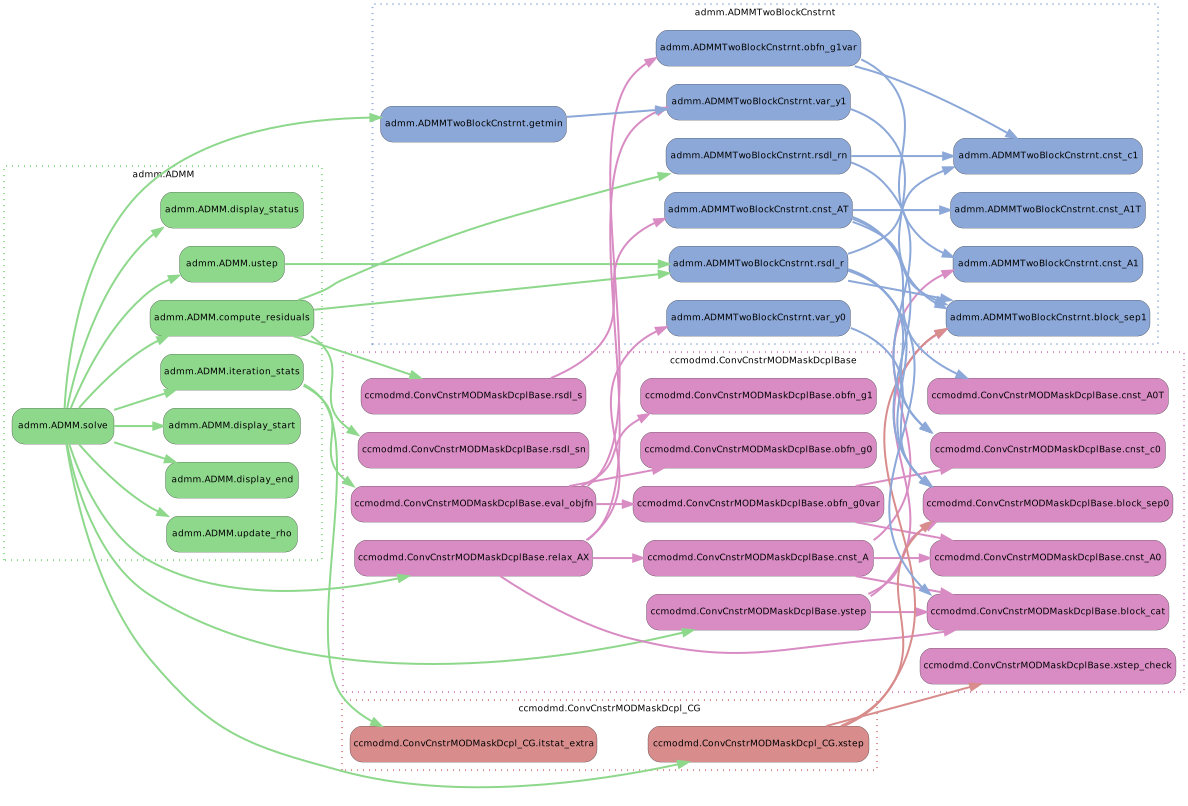
ConvCnstrMODMaskDcplBaseADMM algorithm for Convolutional Constrained MOD with Mask Decoupling [28] with the \(\mathbf{x}\) step solved via Conjugate Gradient (CG) [53].
Multi-channel signals/images are supported [51]. See
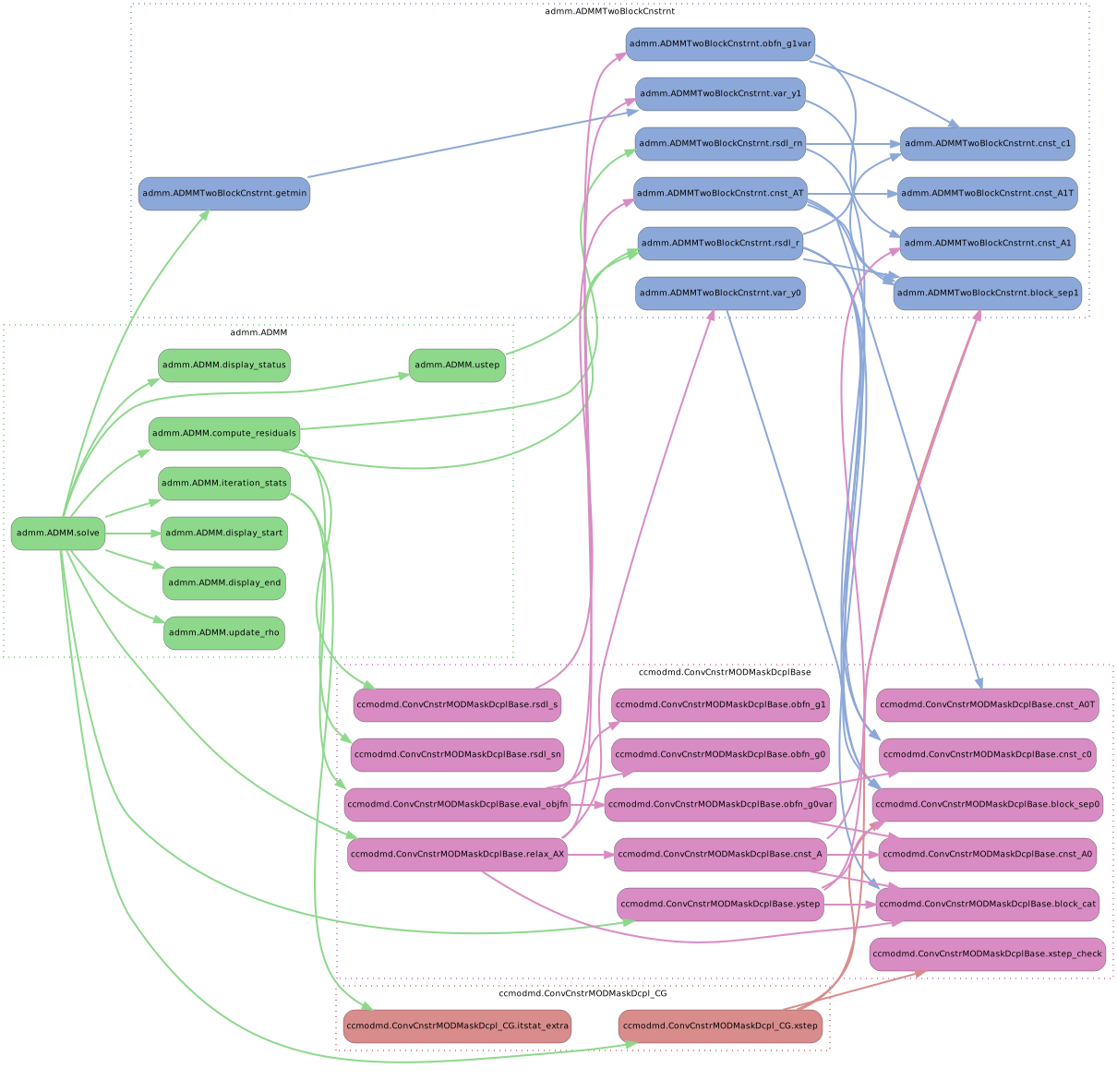
ConvCnstrMODMaskDcplBasefor interface details.Call graph

- class Options(opt=None)[source]
Bases:
OptionsConvCnstrMODMaskDcpl_CG algorithm options
Options include all of those defined in
ConvCnstrMODMaskDcplBase.Options, together with additional options:
CG: CG solver options
MaxIter: Maximum CG iterations.
StopTol: CG stopping tolerance.
- Parameters:
- optdict or None, optional (default None)
ConvCnstrMODMaskDcpl_CG algorithm options
- defaults = {'AbsStopTol': 0.0, 'AutoRho': {'AutoScaling': False, 'Enabled': False, 'Period': 10, 'RsdlRatio': 10.0, 'RsdlTarget': None, 'Scaling': 2.0, 'StdResiduals': False}, 'AuxVarObj': False, 'CG': {'MaxIter': 1000, 'StopTol': 0.001}, 'Callback': None, 'DataType': None, 'FastSolve': False, 'IterTimer': 'solve', 'LinSolveCheck': False, 'MaxMainIter': 1000, 'RelStopTol': 0.001, 'RelaxParam': 1.8, 'ReturnVar': 'Y1', 'ReturnX': True, 'StatusHeader': True, 'U0': None, 'Verbose': False, 'Y0': None, 'ZeroMean': False, 'fEvalX': True, 'gEvalY': False, 'rho': 1.0}
Default content and allowed dict keys
- itstat_fields_extra = ('XSlvRelRes', 'XSlvCGIt')
Non-standard fields in IterationStats; see
itstat_extra
- solve()
Call graph
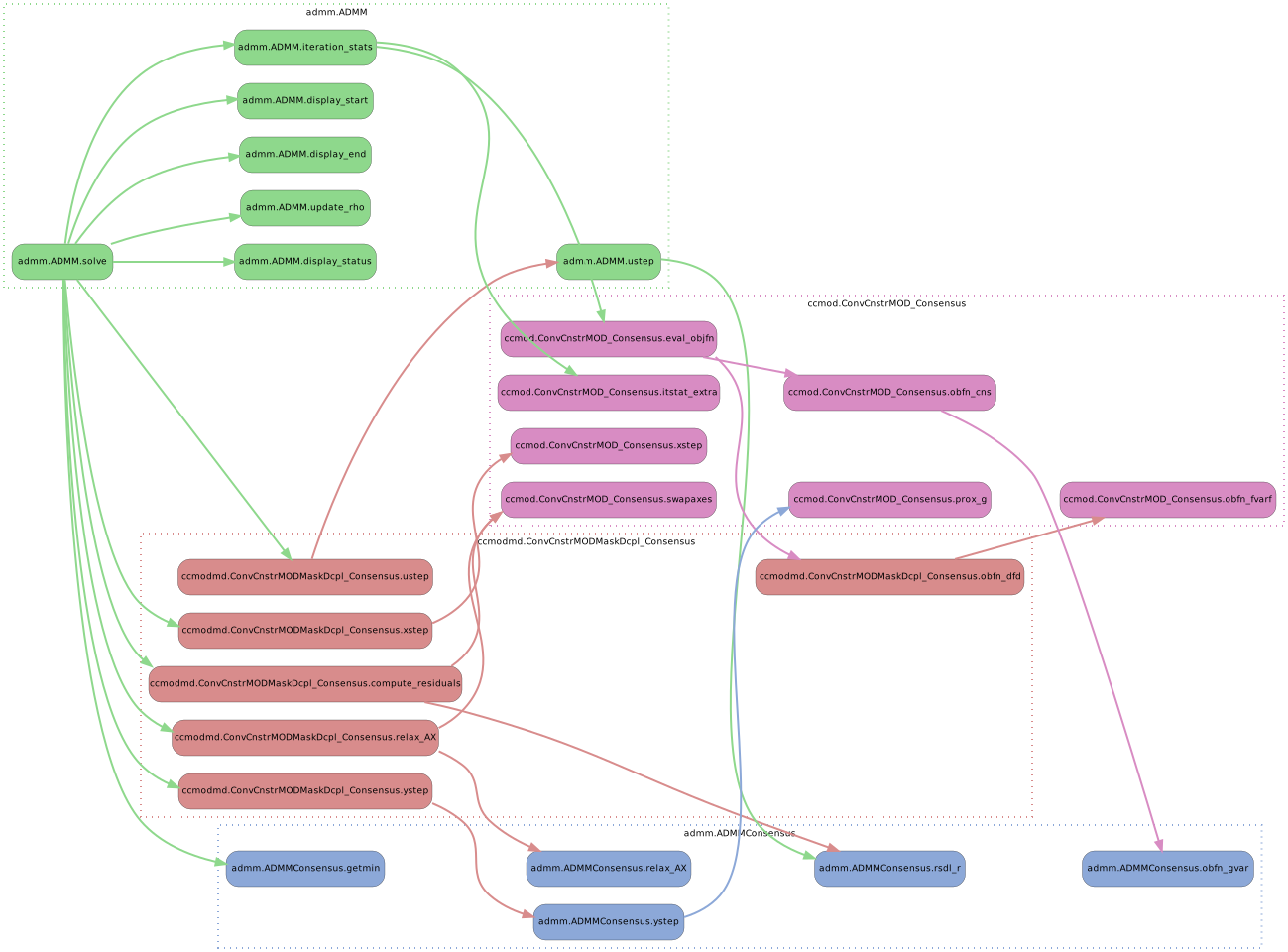
- class sporco.admm.ccmodmd.ConvCnstrMODMaskDcpl_Consensus(*args, **kwargs)[source]
Bases:
ConvCnstrMOD_ConsensusHybrid ADMM Consensus algorithm for Convolutional Constrained MOD with Mask Decoupling [26].
Solve the optimisation problem
\[\mathrm{argmin}_\mathbf{d} \; (1/2) \left\| W \left(\sum_m \mathbf{d}_m * \mathbf{x}_m - \mathbf{s} \right) \right\|_2^2 \quad \text{such that} \quad \mathbf{d}_m \in C \;\; \forall m\]where \(C\) is the feasible set consisting of filters with unit norm and constrained support, and \(W\) is a mask array, via a hybrid ADMM Consensus problem.
See the documentation of
ConvCnstrMODMaskDcplBasefor a detailed discussion of the implementational complications resulting from the support of multi-channel signals.Call graph

- Parameters:
- Zarray_like
Coefficient map array
- Sarray_like
Signal array
- Warray_like
Mask array. The array shape must be such that the array is compatible for multiplication with input array S (see
cnvrep.mskWshapefor more details).- dsztuple
Filter support size(s)
- opt
ConvCnstrMOD_Consensus.OptionsobjectAlgorithm options
- dimK0, 1, or None, optional (default None)
Number of dimensions in input signal corresponding to multiple independent signals
- dimNint, optional (default 2)
Number of spatial dimensions
- var_y1()[source]
Get the auxiliary variable that is constrained to be equal to the dictionary. The method is named for compatibility with the method of the same name in
ConvCnstrMODMaskDcpl_IterSMandConvCnstrMODMaskDcpl_CG(it is not variable Y1 in this class).
- relax_AX()[source]
The parent class method that this method overrides only implements the relaxation step for the variables of the baseline consensus algorithm. This method calls the overridden method and then implements the relaxation step for the additional variables required for the mask decoupling modification to the baseline algorithm.
- xstep()[source]
The xstep of the baseline consensus class from which this class is derived is re-used to implement the xstep of the modified algorithm by replacing
self.ZSf, which is constant in the baseline algorithm, with a quantity derived from the additional variablesself.Y1andself.U1. It is also necessary to set the penalty parameter to unity for the duration of the x step.
- ystep()[source]
The parent class ystep method is overridden to allow also performing the ystep for the additional variables introduced in the modification to the baseline algorithm.
- ustep()[source]
The parent class ystep method is overridden to allow also performing the ystep for the additional variables introduced in the modification to the baseline algorithm.
- obfn_dfd()[source]
Compute data fidelity term \((1/2) \| W \left( \sum_m \mathbf{d}_m * \mathbf{x}_m - \mathbf{s} \right) \|_2^2\).
- solve()
Call graph